
The Scam Patterns Every Skin Investor Eventually Meets
Skin scams look infinite — new sites, new bots, new stories every month. They aren't. Underneath the costumes there are maybe six patterns, recycled for a decade because they keep working on people who've never seen the pattern named. Name them once and most of the danger evaporates. This is the catalog.
Why skins attract this much fraud
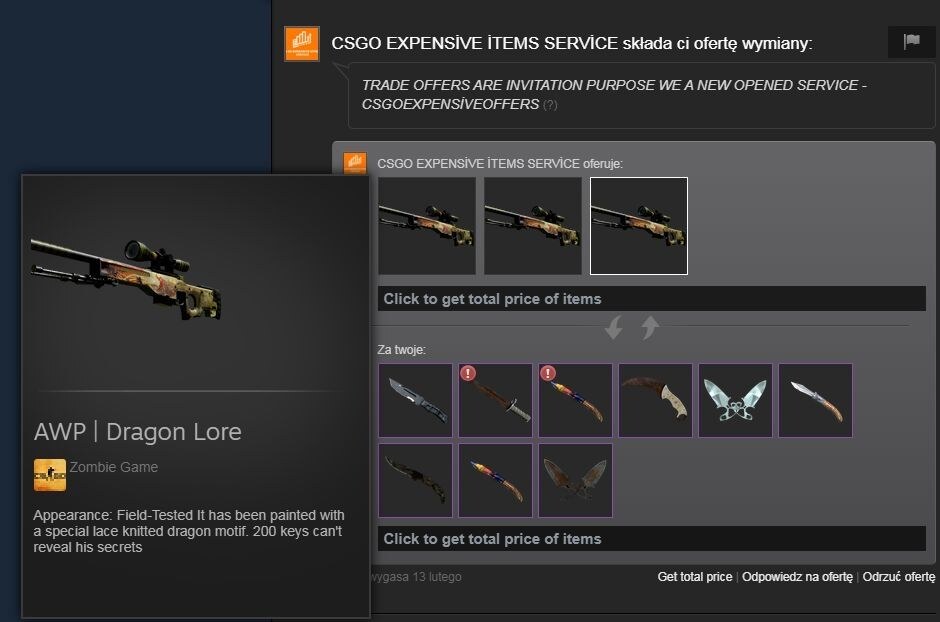
Three properties make CS2 items a scammer's favorite asset: they're valuable, transfers are effectively irreversible once completed, and the victim pool includes teenagers and casual players rather than hardened traders. Valve has narrowed the third property over the years — trade confirmations, holds, and the reversible-trade window introduced with the 2025 Trade Protection update all blunt the classic smash-and-grab. But protections change costumes, not patterns. The patterns:
Pattern 1: API-key phishing
The crown jewel of modern skin theft. You log into a fake site that looks like a legitimate marketplace or inventory tool — often reached from a "vote for my team" or "check this price" link — and it walks you through a real-looking Steam login. What it harvests isn't just your password: it registers or steals your Steam Web API key, which lets the attacker observe and manipulate your trading activity remotely. The signature move is the trade offer swap: you create a genuine trade, the malware cancels it and instantly re-issues a near-identical offer to a lookalike account, and you confirm the theft yourself.
The tells: any login page reached from a link someone sent you; any site asking you to "verify" a working API key; a trade offer that briefly cancels and reappears. The defenses: periodically check your registered API key on Steam's own site and revoke anything you don't recognize; type marketplace URLs yourself; read the trade partner's account on the confirmation screen, every time. If you run automated tools, key handling is its own discipline — the API-key security primer covers storage, scoping, and revocation properly.
Pattern 2: the fake middleman
A P2P deal is going smoothly, and a helpful third party appears — often "recommended" by the buyer — to escrow the trade "for safety." The middleman is the buyer's alt. Variants include fake marketplace bots (an account named to look like a platform's official bot) and fake "Valve staff" who need your item to "verify" it. The pattern's engine is borrowed authority.
The tell: any trade structure where safety depends on a specific account being who it claims to be. Real platforms don't do business through DMs, and Valve employees do not trade with users, ever. If a deal needs an escrow you didn't independently choose, the deal is the scam.
Pattern 3: the impersonator
An account with the name, avatar, and profile of someone you'd trust — a known trader, a streamer, a friend whose account was cloned — approaches with an opportunity. Profile cloning takes thirty seconds. The impersonation targets your social verification instead of any technical system, which is why it survives every Valve update.
The tell: the relationship arrived with the offer. Verify people through a channel the approach didn't come from — message your actual friend, check the streamer's actual socials. Any resistance to out-of-band verification is a confession.
Pattern 4: the "price check" and quiet-hype bait
A stranger DMs asking you to "price check" an item, or floats that a skin like yours is "about to spike" — anything to start a conversation that ends on a phishing link or a manipulated trade. The industrial-scale sibling is coordinated hype: Discord and social pushes that pump a thin, illiquid item so early holders can exit onto believers. If you can't tell who's paying for the enthusiasm, it's you. (A sober look at what moves prices for real — supply mechanics, player counts, updates — is the antidote to manufactured urgency.)
The tell: unsolicited interest in your inventory, from anyone, for any stated reason. Nobody who matters needs a stranger's price check.
Pattern 5: the too-good marketplace
A site with prices 20% below everywhere else, a deposit bonus, aggressive ads — and, once your money or items are in, withdrawal "verification" that never completes. Sometimes it's an exit scam from day one; sometimes a real site that dies and takes balances with it. The line between scam and failure barely matters from inside; both are covered by the same hygiene: established venues only, minimal balances, withdraw often. That discipline has its own chapter in Marketplace Risk.
The tell: the deal is the marketing. Legitimate marketplaces compete on fees measured in single percentage points; nobody real is 20% cheaper than the market that sets the price.
Pattern 6: the gambling funnel
Case-opening sites, coin flips, jackpot wheels — some rigged outright, most simply carrying house edges that make Valve's official 0.26% knife odds look generous, and many historically promoted to minors with fake "won big" testimonials, a story as old as the 2016 gambling scandal. Not always a scam in the legal sense; almost always a wealth transfer in the practical one.
Where automation fits: smaller surface, one crown jewel
Notice what almost every pattern requires: a human, in a conversation, clicking a link or confirming a trade under social pressure. A buy-side bot removes nearly all of that surface. cs2stack, for instance, never sends or receives manual trade links, never chats with counterparties, and only transacts with two established marketplaces — DMarket and SkinBaron — through their official APIs, on a fixed schedule, within hard budget caps. There is simply no moment in its loop where a fake middleman or a swapped trade offer can be introduced. It even guards against self-inflicted errors: item names are validated against live markets before any money moves, which is how a mistyped "Gamma 3 Case" — an item that doesn't exist — got caught in configuration instead of at checkout. The name-validation story is small, but it's the same principle as scam defense: never act on an unverified string.
The honest trade-off: automation concentrates risk into credentials. Your marketplace API keys become the crown jewels — anyone holding them holds your buying power and, on some platforms, your balances. So the standard rises accordingly: keys stored securely, scoped minimally, never pasted into "checker" sites (see pattern 1), rotated if in doubt, and paired with structural limits so that even a stolen key has a bounded blast radius. Per-day budget caps, per-item price ceilings, and a hard spending ceiling mean the worst day a leaked key can cause is a capped day — safety engineering for buying bots goes deep on this, and the list of things a bot should never be allowed to do is the checklist to hold any tool against, ours included.
The mindset that actually protects you
Paranoia doesn't scale — you can't research every link forever. Pattern recognition does. Six shapes cover nearly everything: harvested credentials, borrowed authority, cloned identity, manufactured urgency, too-good economics, and rigged games. When something new appears, don't ask "is this the scam I read about?" Ask "which of the six is this wearing?" The costume changes monthly. The catalog hasn't grown much in a decade — and now you have it.