Surviving Skin Market Crashes: A Stacker's Playbook
If you hold CS2 items long enough, you will wake up to a red portfolio and a Discord full of people typing in all caps. This is not a possibility to hedge against — it's a scheduled feature of the asset class. The stackers who come out ahead aren't the ones who dodge crashes. They're the ones who decided, in advance, what a crash changes. Usually: almost nothing.
Know which crash you're in
Skin crashes come in two species, and telling them apart is most of the intellectual work.
Update-driven crashes start with a changelog. Valve alters a mechanic and specific categories reprice against each other — the October 2025 trade-up update sent Covert prices up and knife prices down within days of the announcement. These crashes are sharp, category-specific, and informative: the market is digesting a real change in the rules. The question they force is whether your items' thesis changed, not whether the sky is falling. Updates move this market every time; the biggest crashes on record are mostly this species.
Macro-style crashes have no changelog. Sentiment turns, a big holder distributes, a hype cycle exhausts itself, seasonal money leaves — prices sag broadly and no single item is "to blame." These are slower, broader, and mostly meaningless for a supply-shrink thesis: nothing about case attrition paused because sentiment did — opened cases stayed opened, and the drop pool kept diluting on schedule. Historically, they're where patient accumulators built their best cost bases.
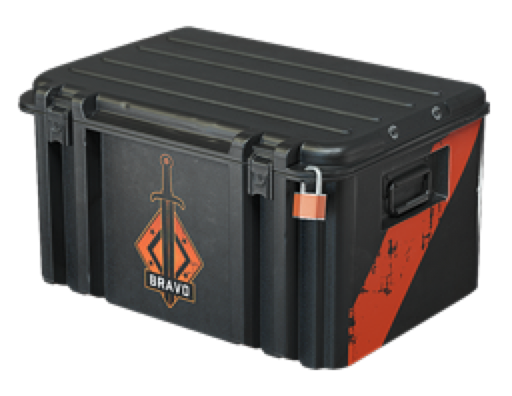
The distinction matters because the correct responses are opposite in one specific scenario: an update crash can break a thesis, a sentiment crash almost never does. Operation Bravo Case holders have sat through every panic since 2013; the case's story is a decade of drawdowns that changed nothing about how many sealed copies remain.
Why DCA carries through a crash
Dollar-cost averaging — buying a fixed amount on a fixed schedule — is frequently sold as a bull-market convenience. It's actually crash equipment. Three reasons:
- Crashes lower your average cost automatically. A fixed daily budget buys more cases when they're cheap. The drawdown that shrinks your portfolio's paper value is simultaneously improving every future purchase. This is mechanical, not motivational: the same $20 that bought four cases at the top buys five or six near the bottom, and nobody had to feel brave for it to happen.
- It removes the timing decision at the worst possible moment. Mid-crash is when human forecasting is at its most confident and least accurate. A standing schedule means you never have to be right about the bottom, only right about the decade. Buying through a correction covers the psychology in detail.
- It caps the damage of being wrong. If the crash deepens, you committed only that day's budget, not a heroic lump sum. Small size is the survival trait; drawdown math explains why a position you can hold beats a position you had to sell.
Veterans have a shorthand for all this: bear markets are for stackers. The years that felt worst to live through tend to look, in hindsight, like the entry windows.
Keep records, especially now
A crash is where sloppy bookkeeping becomes expensive. Without a per-purchase record you don't actually know your average cost, which means you don't know whether you're down 40% or 8% — and people who don't know their numbers make decisions with their pulse instead. The screenshots flying around during a panic are always somebody else's numbers: their entry, their size, their timeline. Your ledger is the only document in the room that's about you. A proper cost basis, maintained automatically, turns "everything is crashing" into "my Fracture position is 12% underwater and my Bravo position is still green," which is a sentence a calm person can act on. This is one of the quiet arguments for an append-only purchase ledger: the record you'll want mid-panic has to have been written before the panic.
When pausing is actually correct
"Keep buying" is the default, not a religion. There are legitimate reasons to stop, and they share one property: they're about the thesis, not the price.
- The mechanic your items depend on changed. If a patch removes or replaces the reason an item class holds value — as capsule buyers learned when sticker capsules were discontinued in favor of a token shop in 2026 — continuing to buy is not discipline, it's denial. Reassess, then redirect the budget.
- Your personal finances changed. Skin budgets are entertainment money. If the money stopped being spare, the correct daily buy is zero, at any price.
- You were overconcentrated and the crash proved it. Pausing to rebalance across more items is fine. Pausing because red numbers hurt is the one move that reliably converts temporary drawdowns into permanent losses.
A price drop alone — even a violent one — appears nowhere on that list. If the supply keeps shrinking and the players keep playing, a cheaper case is the same asset at a better price. When to STOP buying a case draws the full decision tree.
The playbook on one index card
Diagnose the species: changelog or sentiment. If a changelog, reread your thesis item by item and cut what actually broke. If sentiment, change nothing. Let the fixed budget keep buying. Check your ledger, not the subreddit. Never add money you'll need soon, never sell to make the feeling stop, and write down today's decision so future-you can audit it. If the whole card fits in one sitting, that's the point — a crash plan you can't execute while rattled isn't a plan, it's literature. Holders with this playbook have walked through every crash this market has produced — not unscathed, but solvent, positioned, and usually early into the recovery everyone else watched from the sidelines.