What TF2's Economy Teaches CS2 Holders
Before CS:GO had a single skin, Team Fortress 2 had keys, crates, and a functioning item economy. That economy is now more than fifteen years old, has survived neglect, hyperinflation scares, and one genuine catastrophe — and it still trades every day. For a CS2 holder staring at a halved market and wondering whether skin economies simply die, TF2 is the longest-running answer we have. It says: not easily.
The original Valve economy
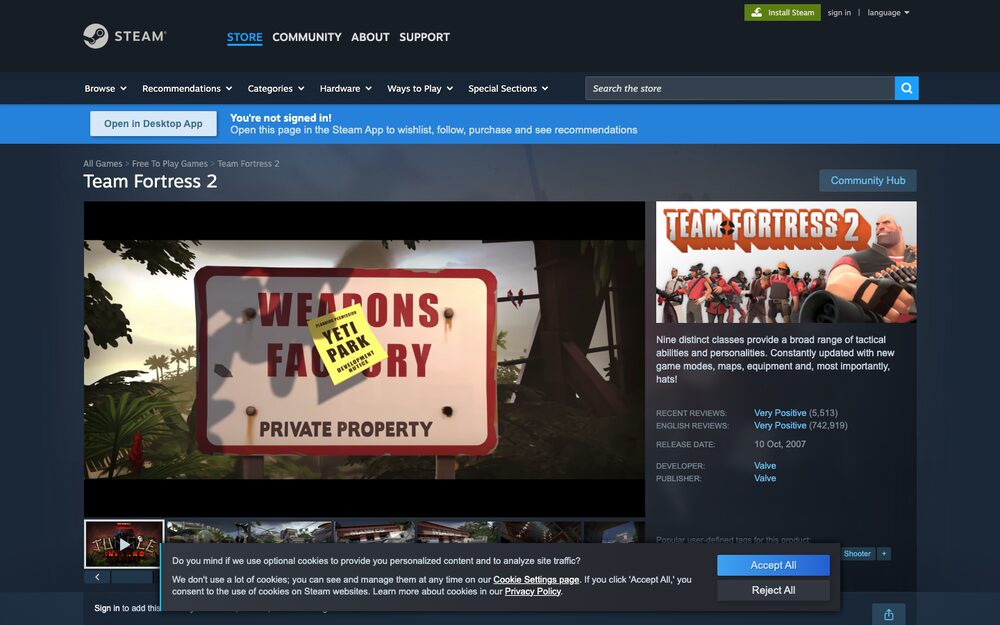
TF2's "Mann-conomy" update shipped in 2010, three years before CS:GO's Arms Deal. It introduced the template CS2 inherited wholesale: crates that drop for free, keys sold for real money to open them, a rare cosmetic tier (unusual hats, with particle effects) that became the grail class, and community-run trading on top. When TF2 went free-to-play in 2011, the item economy became the business model itself — a bet that a shooter could fund itself indefinitely on cosmetics, which is precisely the bet Valve later scaled up with CS:GO.
TF2 even solved a problem CS2 never had to: with no liquid mid-tier currency, players adopted keys and refined metal as money, complete with community-maintained exchange rates, price sheets, and trading hubs that functioned as an over-the-counter market years before third-party skin marketplaces existed. Every structural feature skin investors now analyze — supply that burns on opening, grails priced by scarcity and provenance, keys as the unit of account, community price discovery — ran in TF2 first, with a decade's head start of data.
The inheritance, feature by feature:
| Structural feature | TF2 (Mann-conomy, 2010) | CS2 version |
|---|---|---|
| Container + paid key | Crates drop free, keys sold to open them | Cases and keys, inherited via the Arms Deal |
| Grail class | Unusual hats with particle effects | Rarest-tier items priced by scarcity and provenance |
| Currency-like items | Keys and refined metal as money | Cases and liquid mid-tier skins |
| Price discovery | Community price sheets and trading hubs | Third-party cash marketplaces |
The crate depression: a real catastrophe, absorbed
In 2019 TF2 suffered the worst shock a randomized-item economy can take. A bug briefly made certain old crates guarantee an unusual hat on opening — the rarest tier in the game, suddenly mintable at will. Players opened crates en masse before the fix. Per community documentation, Valve responded by freezing trading on the bugged-era unusuals and then partially restoring it with restrictions; the affected hats became their own discounted sub-class. The details are argued about to this day, but the headline is not: an economy took a hyperinflation-grade supply shock to its most valuable asset class, and it functioned anyway. Prices for clean unusuals repriced, trading continued, and the market carried on. Set that against CS2's own crash history and the pattern is identical: the shock reprices assets; it does not kill the economy.
Worth sitting with the comparison for a second. CS2's 2026 drawdown, brutal as it feels, was a demand shock — sentiment, leverage, and cash-outs against fundamentally unchanged items. The crate depression was worse in kind: the integrity of the rarity system itself broke. If the graver failure mode couldn't end TF2's market, a repricing alone was never going to end CS2's.
Persistence without hype
Here is the part that should genuinely comfort a CS2 holder. TF2 has run for years on a small fraction of CS2's player base, long stretches with minimal developer attention — community updates measured in years, not seasons — no esports engine to speak of, and no institutional narrative. Nobody wrote asset-class theses about hats. And yet its items still clear, its keys still hold value against a slowly drifting exchange rate, its grails still find buyers when they surface. If a virtual economy that neglected can persist for fifteen years, the bar for killing one with CS2's player numbers is extraordinarily high — which is exactly why the 2026 gap between strong engagement and crashed prices reads to many as a sentiment problem, not a fundamentals problem.
Where the comparison honestly breaks
TF2 is a precedent, not a mirror, and the differences cut both ways:
- No esports engine. CS2's Majors, sticker economy, and pro-scene attention cycle have no TF2 equivalent. That's demand TF2 never had — and demand that could, in theory, fade.
- Thinner rails. TF2 trading lives mostly on Steam and community sites. CS2 has deep third-party cash marketplaces, which add liquidity and also add cash-out reflexivity in crashes.
- No China factor. TF2 never had a demand bloc like Chinese CS players, whose venues and flows can move the whole market.
- No institutional money. TF2 items were never seriously pitched as an alternative asset class. CS2's speculative capital amplifies both booms and busts — 2026 being exhibit A.
The lessons, distilled
None of this makes TF2 a price target for CS2 — hats never had a 2021-style bull run to give back, and per third-party trackers TF2's aggregate item values have spent most of their history drifting rather than compounding. The comparison is about survival mechanics, not returns. Strip the two economies to what transfers, and TF2 leaves CS2 holders four durable lessons. Valve item economies are long-duration assets — they measure their lives in decades, not hype cycles. Crashes, even grotesque ones, get absorbed and repriced rather than ending the game. The realistic tail risk is neglect — a slowly shrinking player base — not shutdown, which is why CS2's engagement numbers matter more than any single price chart. And liquidity concentrates in currency-like items: TF2's keys and metal, CS2's cases and liquid mid-tier skins, the instruments that survive every regime. That last one is quietly the argument for the accumulation style this site keeps returning to: if the economy's lifespan is measured in decades, the post-crash question isn't whether to be in the market this month, but whether you can stay in it cheaply, steadily, and without emotion for years.