Player Counts vs Skin Prices: the 2026 Decoupling
For years the skin market ran on one comfortable rule of thumb: more players, higher prices. Then 2026 broke it. CS2's player counts held near historic strength all through the crash — while, per third-party trackers, roughly 95% of tracked skins fell anyway. The gap between those two lines is the most important chart in the market right now, and reading it correctly changes what kind of bear market you think you're in.
The rule that broke
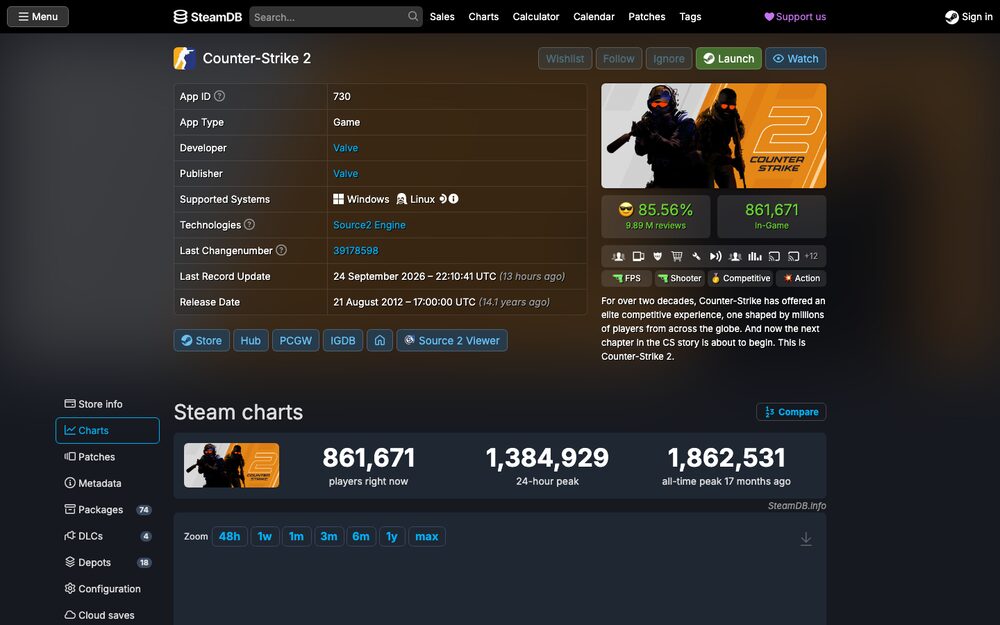
The old logic was simple and, for a long stretch, correct. Player growth meant more people unboxing, more people wanting inventory, more money flowing in — and player counts and skin prices climbed together through CS2's record-breaking run, with concurrent peaks above 1.8 million per public trackers. The correlation was so reliable that "check the player chart" became the entire due-diligence process for a lot of holders.
Mid-2026 delivered the counterexample. Engagement stayed strong — daily concurrents held in the same historically elevated band they'd occupied through the bull run, per Steam's own public numbers and the trackers built on them — while the market that sits on top of that engagement roughly halved from its ~$14B peak, per third-party analyses. Players kept playing. Prices fell anyway. One of those "reliable" variables turned out not to be the driver people assumed it was.
A skin price is two prices
The cleanest way to make sense of the decoupling is to split every skin price into two components. The first is utility value: what someone who actually plays the game will pay to hold the item, look at it, and use it. The second is speculation premium: what someone pays for the chart — the expectation that the price keeps going up, backed by the scarcity story and three years of green candles.
Utility value moves with players. Speculation premium moves with belief. Through 2024 and 2025 the premium compounded on top of utility until, on many items, it was most of the price — a structure the market shares with every collectible mania, and one reason the "skins as an asset class" framing always came with caveats. What 2026 crushed was the premium. The Dec 2025 drop-pool shock and the repricing that followed didn't make anyone enjoy their AK skin less; it made people stop believing the number always goes up. That belief was worth, per third-party trackers, several billion dollars.
The floor is still holding
Here's what strong player counts actually buy you in a crash: throughput. Every hour of play generates drops, opens cases, feeds trade-ups, and puts items in front of people who want them. Per third-party analyses, players opened on the order of 400 million cases in 2025 — and unboxing did not stop when prices fell. Market volumes through the crash tell the same story: activity persisted even as prices marked down, which is what a repricing looks like, not what an exodus looks like.
That's the demand floor. It doesn't set the price of a Dragon Lore, but it sets the level below which liquid items struggle to fall while millions of people are in the game every day wanting things. Utility value is boring, slow, and — on 2026's evidence — real. It's the part of the market that didn't crash.
What actually drove the crash
If demand held, the driver was elsewhere — and it was: supply policy. On Dec 17, 2025, Valve zeroed the Rare Drop Pool, pulling 35+ cases out of active drops in one patch, per dataminers. Then the mid-May 2026 update adjusted drop rates and added cases back into circulation. Add the Oct 2025 trade-up change that wiped roughly $1.75B of paper value per third-party analyses, and you get a market that learned, three times in eight months, that the supply schedule underpinning its scarcity math can be rewritten by one publisher on any Wednesday.
Put the timeline in one place and the driver is unmistakable:
| When | What moved | Type | Effect |
|---|---|---|---|
| Oct 2025 | Trade-up mechanic change | Policy shock | ~$1.75B paper value wiped, per third-party analyses |
| Dec 2025 | Rare Drop Pool zeroed | Policy shock | 35+ cases pulled from drops; violent repricing |
| May 2026 | Drop rates adjusted, cases restored | Policy shock | Supply lever pulled the other way, mid-crash |
| Throughout | Player concurrents | Demand | Held in the historically elevated band |
That's a policy-shock bear market, not a demand-collapse bear market. The distinction matters enormously for recovery: demand collapses need new buyers to appear; policy shocks need the existing, still-present buyers to trust the rules again. The long-term thesis audit comes down largely to that question.
What would flip the thesis
The honest version of this argument names its own kill switch. The decoupling is bullish only while engagement genuinely holds. A real demand bear market would look different, and it would show up in public data first:
- Sustained concurrent decline — not a seasonal dip, but quarters of lower highs and lower lows on the player chart.
- Unboxing throughput falling — case-opening volume rolling over per trackers, meaning players are disengaging from the item economy specifically.
- Volume drying up with prices — markdowns on no activity, the signature of buyers leaving rather than repricing.
- A genuine competitor exodus — a shooter actually pulling CS2's core hours, something no title has managed in a decade.
None of those are in the data today, per public trackers. Until they are, the player chart is the strongest single input in the bottom-watching toolkit: it says the customers are still in the building, arguing about prices — not gone.
For holders, the practical read is that this is the kind of drawdown where the underlying engine kept running. That doesn't date the bottom or promise your item back at its highs. It does mean the recovery question is "when does the premium rebuild on top of an intact floor" — a much better question than "where did everybody go."