Does the Long-Term Skin Thesis Survive 2026?
For five years, the bull case for CS2 skins was simple enough to fit in a tweet: supply burns, demand grows, and the company running the casino wants the casino healthy. Then 2026 cut the market roughly in half. An honest holder doesn't ask whether the crash hurt — it did — but whether it broke the reasoning. So let's audit the thesis, pillar by pillar.
The thesis, as it stood before the crash
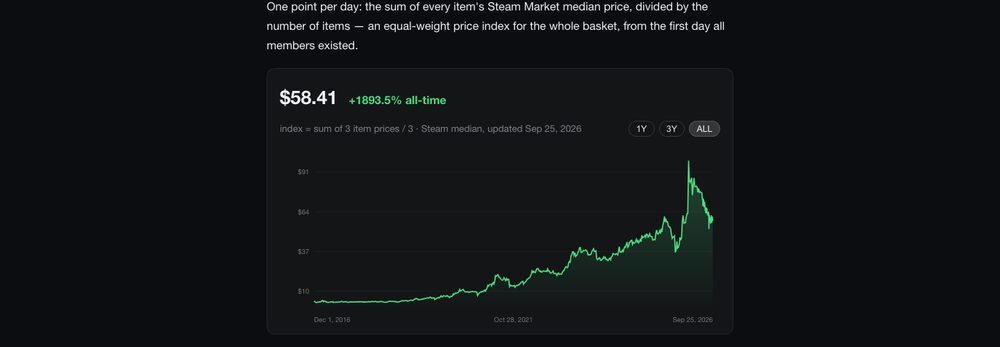
The long-term case rested on three pillars. First, deflationary supply: every case opened is destroyed forever, and per third-party analyses players opened on the order of 400 million cases in 2025 alone — a burn schedule no other collectible asset runs at. Once a case leaves active drops, its float supply only shrinks.
Second, durable demand: CS2 kept setting concurrent-player records, and player counts held strong even while prices halved. Behind the western venues sits the Chinese demand bloc, which per trackers often sets the marginal price of the market's most liquid items.
Third, an aligned operator: Valve is not a neutral bystander. Per third-party analyses, CS2 generated over $1.16 billion for Valve in 2025 — roughly 400 million case openings at $2.50 a key, plus an estimated $166 million in marketplace fee profit. The 15% machine only prints when the market is alive. A company earning a billion dollars a year from an economy has a billion reasons not to kill it.
Put together, the three pillars produced the returns that made the thesis famous: through 2021–2025, per tracker data, broad baskets of discontinued cases compounded at rates public equities never touch. The question 2026 forces is whether those returns came from the pillars — or from something more fragile riding on top of them.
What 2026 actually broke
Not the pillars — the hidden assumption underneath them: that Valve's supply policy was stable. The thesis quietly treated the drop pool, the trade-up rules, and the case pipeline as slow-moving constants. Then October 2025's trade-up change wiped an estimated $1.75 billion in paper value per third-party analyses. On December 17, 2025, the Rare Drop Pool went to zero and 35+ cases left active drops overnight. And in mid-May 2026, Valve reversed course again, adjusting drop rates and adding cases back. Three regime changes in eight months, each repricing the market in hours.
The crash also exposed how much of pre-2026 pricing was speculation premium rather than utility value. Part of what a skin is worth comes from people wanting to use it; the rest comes from people expecting to sell it higher. The second component is the one that evaporates first, and 2026 showed it was a bigger share of the price than most holders admitted — especially at the top of the market, where items had become almost pure financial instruments.
Worse for the diversified: when roughly 95% of 1,186 tracked skins fell between March and mid-August per one widely-cited analysis, diversification inside the asset class turned out to be mostly cosmetic. In a policy shock everything correlates, from gloves (down 10–20% early) to the cheapest active-drop cases. Spreading a portfolio across fifty items is not spreading risk when all fifty reprice on the same patch notes. You cannot diversify away the variable that matters most: one company's decisions.
What survived the audit
Quite a lot, actually. The burn never stopped — cases kept being opened and destroyed at enormous scale straight through the drawdown, which means the supply of every discontinued case is thinner today than it was at the peak. Engagement never cracked; the demand floor under the market is players, and the players stayed, logging record or near-record concurrents per public trackers even in the ugliest months of the slide.
Valve's incentives didn't move either. The fee engine ran through the crash — volatility itself generates fee revenue, since panic sellers pay the same 15% as euphoric buyers — and the May 2026 adjustment, whatever else it was, demonstrated that Valve watches the market's health and reacts to it. And the longest-running precedent we have — TF2's fifteen-year-old key-and-crate economy, which survived its own 2019 crate depression — suggests Valve economies bend without snapping, even under far less operator attention than CS2 gets.
The audit, pillar by pillar:
| Pillar | Pre-crash claim | 2026 verdict |
|---|---|---|
| Deflationary supply | Every case opened is destroyed forever | Intact — the burn ran at scale straight through the drawdown |
| Durable demand | Record player counts, plus the Chinese demand bloc | Intact — engagement never cracked |
| Aligned operator | A billion-dollar incentive to keep the economy alive | Intact — the fee engine ran, and May 2026 showed Valve reacts |
| Stable supply policy (hidden) | Quietly treated as a constant | Broken — three regime changes in eight months |
The scoreboard, honestly kept:
- What changed: supply policy is now a live risk, not a constant; the speculation premium was larger than admitted; intra-market diversification offers less protection than holders assumed.
- What didn't: case destruction mechanics; a huge, engaged player base; Valve's billion-dollar incentive to keep the economy functioning; the historical pattern of recovery after every prior crash.
The verdict: dented, not broken
The thesis survives — with markdowns. Expected returns should be lower than the 2021–2025 era implied, because the market now (correctly) charges a premium for policy volatility, and because some of those historical returns were the speculation premium inflating itself. Position sizing matters more than item selection: skins remain an alternative asset with real structural weaknesses — no regulation, no legal ownership, one-company platform risk — and the correct allocation is a satellite position funded with money you can lose, never a core holding.
What the crash changed most is the entry math. A halved market with intact demand and running supply burn is a better starting point than the same market at its peak — whether now is actually a good time to buy depends less on the thesis than on your horizon and discipline. The reasoning held. The price of believing it just got cheaper.