
DMarket vs CSFloat (2026): API Automation vs P2P Value
DMarket and CSFloat are two of the best deals in the western market — for different jobs. One holds inventory on-site and hands machines an API; the other connects you to thousands of individual sellers with the best float data in the business. Both can get you skins cheaper; this comparison shows which winner fits your use case, jobs first, numbers second.
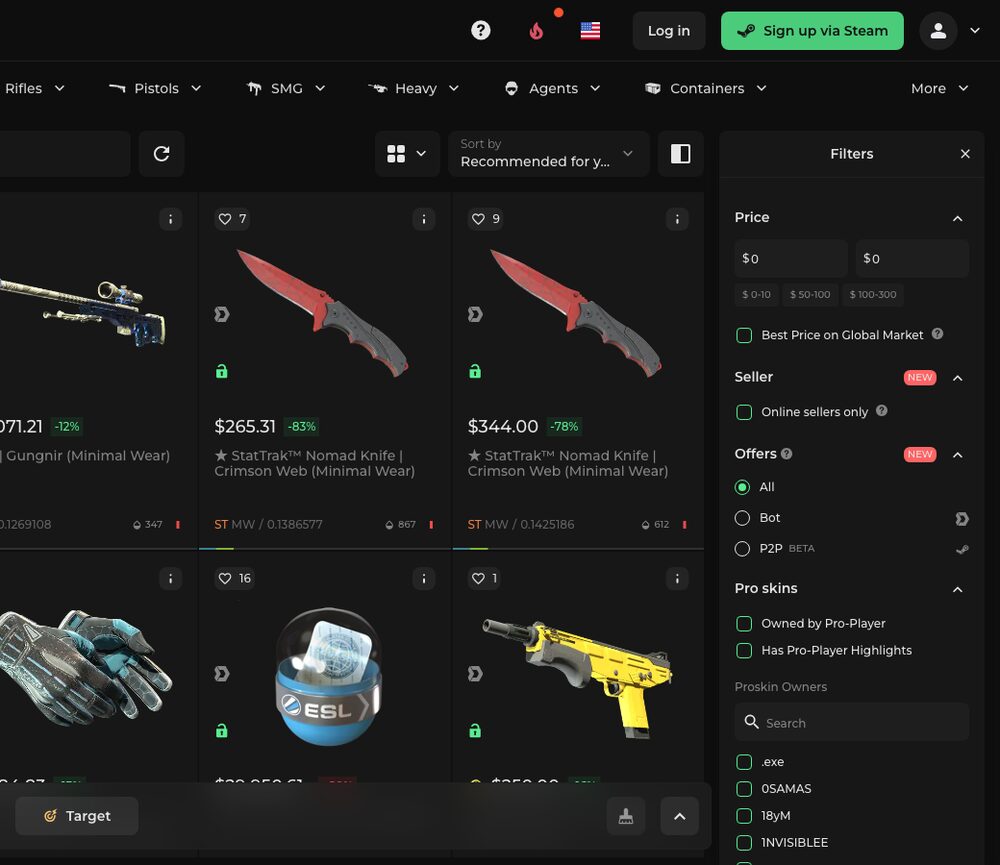
Two architectures, briefly
DMarket is an on-site balance venue: sellers deposit items into DMarket's custody, buyers pay from a funded balance, and a purchase transfers ownership instantly on the venue's books — no Steam trade window in the critical path. It also publishes a full public trading API, which makes it one of the few venues where software can search, buy, and confirm a purchase end to end. Details in our DMarket review.
CSFloat is a peer-to-peer venue: sellers keep items in their own Steam inventories, buyers pay into escrow, and the seller ships the item via a Steam trade offer. Its fee schedule is among the leanest in the western market — low single digits for sellers per its published pages in late 2026 — and its float and pattern database is the reference tool most of the market uses anyway. Full picture in our CSFloat review.
That architectural split — custody versus peer delivery — is the deepest divider in the entire marketplace landscape, and we've written a structural explainer on P2P vs on-site inventory that this comparison leans on throughout.
The side-by-side
As of late 2026, per each venue's published pages — both change fees and mechanics; verify before trading.
| Dimension | DMarket | CSFloat |
|---|---|---|
| Model | On-site custody, balance-based | P2P escrow, seller ships via trade |
| Seller fees | Roughly mid single digits to ~10%, tiered by item and volume | Low single digits |
| Delivery speed | Instant to your venue inventory | Minutes to hours — depends on the seller |
| Automation | Published trading API; bot-native | Buy orders exist, but delivery needs your Steam account in the loop |
| Float/pattern tooling | Standard filters | Best-in-class database, float rankings, pattern search |
| Seller base | Depositors and pro sellers | Broad — anyone with a Steam inventory can list |
| Cash-out | Balance withdrawal by rail | Seller payouts by rail |
The fee math, honestly
On headline fees CSFloat wins, and it isn't close: a low-single-digit seller cut versus a tiered schedule that can reach twice that. Lean fees attract sellers, sellers bring listings, and listings bring price competition — which is why CSFloat's asks on popular skins are often among the lowest cash prices in the western market.
But the honest math doesn't stop at the fee line. DMarket's custody model means a bought item can be relisted instantly without ever touching Steam's trade lock; CSFloat's peer delivery puts a fresh 7-day trade hold on every item that lands in your inventory. For a buy-and-hold collector that's irrelevant. For anyone flipping, re-routing, or operating on a schedule, the lock is a cost that never appears on a fee page. The general version of this argument — why headline fees mislead — is in our full fee comparison.
Where CSFloat is simply better
- Float and pattern buying. If the tenth decimal of wear matters to you, CSFloat's tooling has no real rival. Float values are its home turf.
- Sharp cash prices. The lean fee draws value sellers; patient buyers with standing buy orders can sit below market and get filled.
- Selling at maximum margin. Low single digits off the top is the best keep-rate among major western venues, if you can wait for a buyer.
Where DMarket is simply better
- Anything unattended. An API plus on-site custody means software can buy, verify, and log a purchase with no human accepting trade offers. That's the whole game for automation — our DMarket autobuy guide walks through it.
- Speed and certainty. Purchases settle instantly; there's no seller who might be asleep, offline, or having second thoughts.
- Operational bulk buying. Cases and liquid items in quantity, on a schedule, with a machine-readable receipt for every fill.
Trust profiles: different risks, not different amounts
Neither venue is the risky one; they're differently risky. DMarket's custody model means your balance and undelivered items sit on its books — venue solvency is your exposure, so cap what you park there. CSFloat's escrow model means each trade depends on a stranger performing, with the venue arbitrating disputes — your exposure is per-transaction friction rather than balance risk. Both have operated for years with track records that third-party reporting treats as solid; size your usage to the risk shape, not to fear.
Different tools for different jobs
The happy verdict: both venues win, each at its own job. Hunting a 0.003-float AK with a specific sticker craft? CSFloat, without hesitation. Accumulating cases every morning while you're at work? DMarket, because unattended buying needs custody and an API, not a trade window. Selling a high-value knife at maximum margin and no hurry? CSFloat's fee wins. Selling into a schedule, or cycling inventory? DMarket's custody wins again.
Our own disclosure: cs2stack buys on DMarket (paired with SkinBaron) precisely because the on-site model is what makes hands-off automation trustworthy — the tool compares both venues on every purchase, enforces your price caps, and logs every fill. That's not a knock on CSFloat; it's a different job. Plenty of our users run both: the bot accumulates on custody venues, and they browse CSFloat themselves for the float-perfect pieces no bot should choose for you.
Neither venue keeps the price lead for long — that's the nature of two healthy marketplaces competing. Make the head-to-head check part of every single purchase and the few percent you save each time quietly snowballs into one of the biggest returns in this hobby.