AK-47 Wild Lotus: The Quiet Five-Figure AK
No operation, no case, no esports moment. A green AK covered in flowers slipped into the game in November 2019 and became the Fire Serpent's only real rival — on supply mechanics alone.
The other grail AK
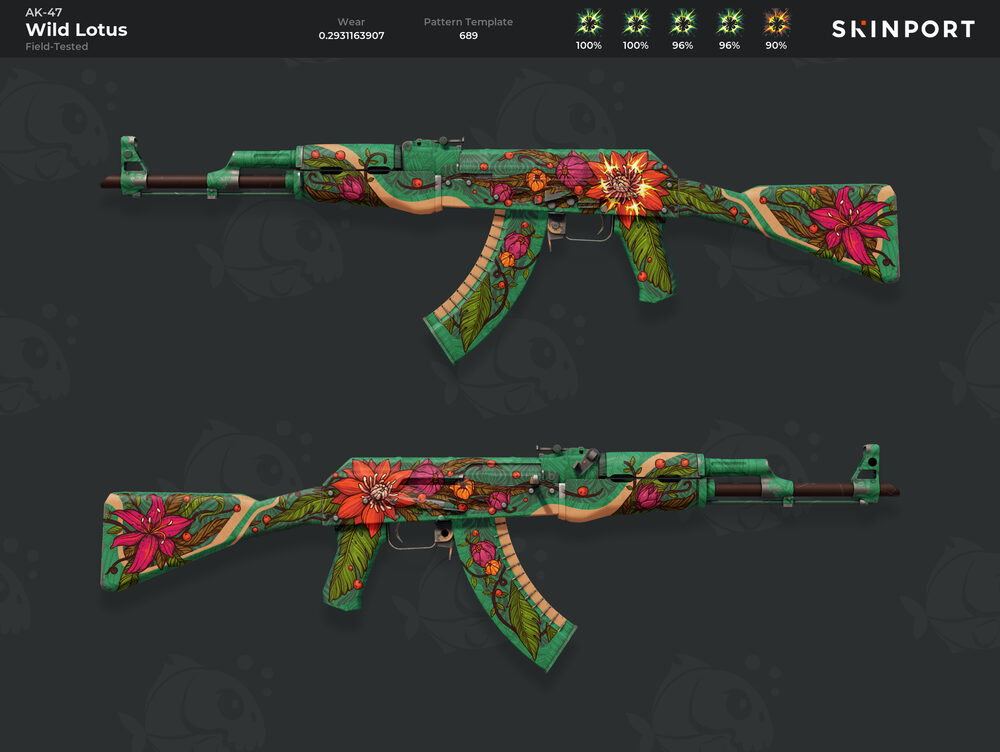
Ask ten players to name the grail AK and nine say Fire Serpent. The tenth has looked at the numbers. The Wild Lotus arrived on November 18, 2019 as the Covert of The St. Marc Collection — the same patch that quietly shipped The Norse Collection and its Gungnir — and it has spent the years since trading in the same rarefied territory as Bravo's crown jewel, reportedly reaching five figures for high grades as of mid-2026, without any of the Fire Serpent's cultural scaffolding.
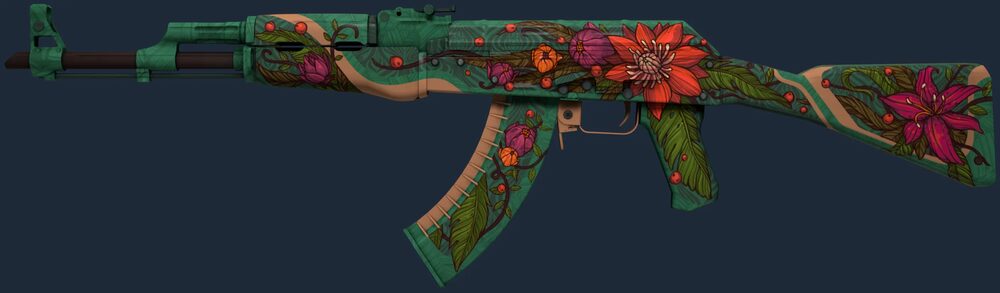
The finish is a full-body botanical: pink lotus blossoms over dense jungle greens, themed after the St. Marc map's Caribbean setting. It's the least aggressive art ever put on the game's most aggressive rifle, and that contrast is the whole aesthetic bet. Where 2013-era grails shout, the Wild Lotus is deliberately, expensively calm.
Supply: thinner than the legend it chases
The St. Marc Collection never had a purchasable container. Like its Norse sibling, its items entered through a narrow, short-lived drop channel tied to that era, and the collection left circulation long ago. No case sits in warehouses waiting to be opened; no operation re-run can top up the pool. The population of Wild Lotuses is effectively a closed set, growing by zero, shrinking slowly through abandoned accounts and bans.
Compare that against the Fire Serpent's supply structure and an irony emerges:
- Fire Serpent has a visible reserve — every sealed Bravo case is a potential new unit, and high skin prices actually pull supply into existence by making openings rational.
- Wild Lotus has no reserve at all. There is no mechanism by which rising prices create new units. On pure mechanics, the flower AK is arguably the harder-capped asset.
- Yet the Fire Serpent trades higher at comparable wear, by most public accounts. Thirteen years of clips, crafts, and recognition outweigh a supply-table advantage. Scarcity sets the floor; culture sets the ceiling.
That gap between the two is one of the market's cleanest live experiments: if pure supply mechanics ever fully win out over legacy, the ratio between these two AKs is where you'll see it first.
A market of anecdotes
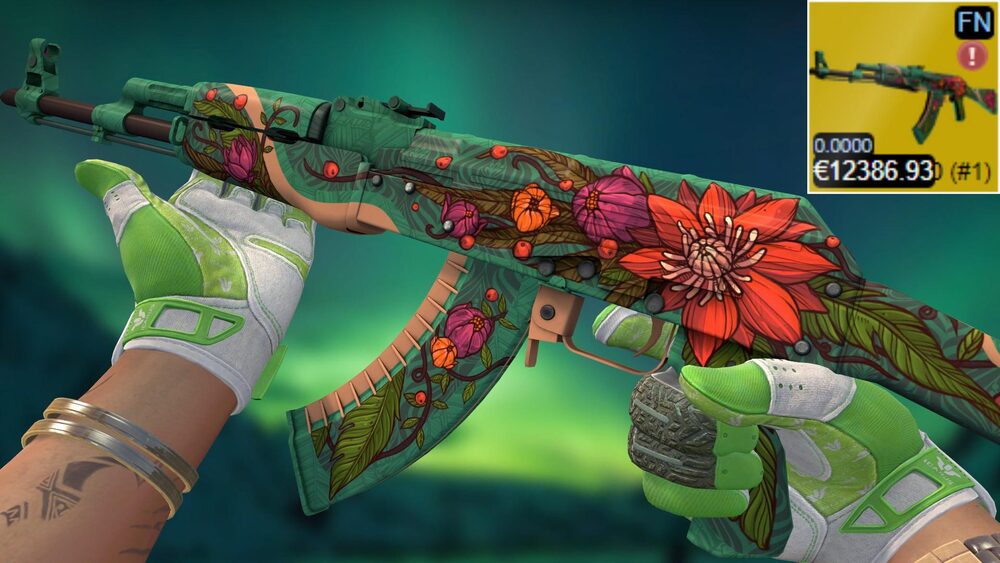
Wild Lotus price history is not a chart, it's a scrapbook. Sales at this tier are sporadic enough that a single motivated buyer or one forced seller can move the reference price for months. Public listings routinely sit far above the last known trade; the real market lives in collector Discords and broker deals, and quoted figures deserve the standard hedges — venue currency matters, and Steam-anchored valuations overstate cash value substantially.
Liquidity, predictably, is the tax. Time-to-sale for a fairly-priced Wild Lotus is measured in weeks or months, spreads are wide, and exiting in a hurry means conceding a chunk of paper value — the mechanics laid out in the liquidity explainer apply here at full strength.
Who actually holds them is telling. The Wild Lotus never developed the Fire Serpent's craft scene — burning Katowice holos onto a pastel flower AK reads wrong, and the population is too small to support a craft meta anyway. Instead the skin gravitated toward a specific holder profile: quiet, long-horizon collectors who treat it as a vault asset rather than a flex. That matters for supply-on-market. At any given moment only a handful of units are genuinely for sale worldwide, and a large share of the population hasn't changed hands in years. Low churn keeps the price anchors stale, which in turn widens the gap between listed asks and what a patient cash buyer actually pays.
What "almost by accident" really means
Nothing about the Wild Lotus was engineered for grail status. The 2019 collections looked like filler content — new map skins, minor patch note, moving on. Grail status emerged from three ingredients nobody coordinated:
- A drop channel so thin that the population stayed collector-scale forever.
- Covert placement on the AK-47, the demand engine that makes any rare AK investable by default.
- An art identity distinct enough that the skin never got confused with anything else in the catalog.
That's the same recipe as every other item in the top-price tier — the Wild Lotus just proves the recipe works without marketing. And it carries the same practical warning as the rest of that tier: a five-figure single item is a concentrated, illiquid position whose return you can't realize until exactly one person shows up. Grails are trophies that sometimes appreciate. The systematic version of this market — accumulating closed-supply assets that trade daily in small units — runs on the same physics with none of the counterparty roulette.
The Wild Lotus thesis keeps working as long as St. Marc supply stays shut and AK demand stays cultural bedrock — both good bets. Whether one illiquid unit is the right vehicle for capturing it is a separate question, and for most portfolios the honest answer is no. Admire the flower; own the mechanics.