
Sniping Without Watching: Price Caps as Standing Orders
There is a version of sniping that requires no reflexes, no alerts, and no being awake. You write down the price at which an item is a bargain, hand the number to a bot that checks the market every day, and go live your life. When a red day comes — and red days always come — you own the dip automatically.
The idea: a limit order, rebuilt from a config line
Stock exchanges solved lazy bargain-hunting a century ago with the limit order: an instruction that says "buy at this price or better, whenever that happens, without asking me again." Skin marketplaces mostly don't offer real limit orders — but a daily bot with a per-item maximum price is functionally the same thing. A config line like:
Kilowatt Case | max $X | daily
means: every day, look for this item across venues; if the best listing is at or under $X, buy it; if not, buy nothing and try again tomorrow. That's a standing order. It never sleeps through a dip, never talks itself into overpaying, and never gets bored in week six. The cap itself is the same safety setting covered in max-price lines — the trick is realizing that a defensive setting, placed below the current market instead of above it, becomes an offensive one.
Why this fills at all
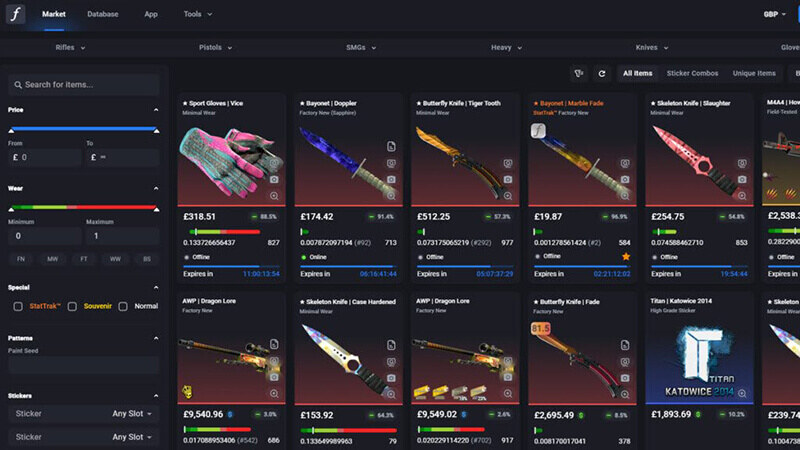
Because skin prices are noisy. Around any case's slow-moving trend there's constant chop: urgency sellers pricing for tonight, weekend dumps, venues repricing at different speeds, market-wide red days when sentiment sours. A cap set modestly under the typical price sits quietly through the green days and catches the noise on the red ones. You're not outracing anyone — the listings a daily check catches are the ones nobody needed to race for. What you're really harvesting is other people's impatience, at a schedule of roughly "a few fills whenever the market wobbles."

A concrete shape (illustrative, not advice): suppose a case you want typically trades around a dollar. Cap a daily line ~10% under that. Most days, nothing happens — the report says "skipped: over cap," which is the system working. Then the market has a bad week, listings dip under your line across a venue or two, and the bot quietly fills day after day at your price. When prices recover, you're holding inventory bought below where it trades — the classic snipe outcome, achieved at reading speed rather than reflex speed.
Two caps, two jobs
It's worth separating the two ways to set a max price, because they're different strategies wearing the same setting:
- Cap above spot (protective). "Buy daily, but never above $X." The line fills almost every day; the cap only bites during spikes. This is DCA with a seatbelt — accumulation is the goal, the cap prevents overpaying into hype.
- Cap below spot (opportunistic). "Buy only under $X." The line fills rarely, on dips. This is the lazy snipe — bargains are the goal, patience is the cost.
Serious setups run both at once: protective caps on the core accumulation lines, plus a couple of opportunistic lines under spot as permanent dip-catchers. The blend — and when to tilt between them — is the subject of DCA into strength or weakness and the broader sniping vs DCA comparison.
What makes it safe to leave running
A standing order you don't watch needs guardrails you can trust, because "unattended" is only a feature if nothing surprising can happen. The checklist:
- Budget caps above the price caps. A dip that undercuts your line across many venues shouldn't buy the whole order book. A per-day budget — in cs2stack's case, plus a $500 hard cap no typo can exceed — bounds the best-case day as well as the worst. See budget caps.
- No double-buys. If a run retries or a scheduler hiccups, the bot must know what it already bought today. Idempotency — the property that re-running an operation doesn't repeat its effects — is what makes "set and forget" honest.
- Rehearsal first. Every new line deserves a dry run: real prices, fake money, an emailed preview of what would have been bought. Caps have typos too; find them before they trade.
- Receipts. Fills you didn't watch happen need records you can audit. An append-only ledger of every purchase — price, venue, FX — turns "did it overpay?" into a lookup instead of a feeling. See the audit trail.
What this doesn't do
Honesty about the limits. A daily-cadence cap will not catch the two-second, 40%-off fluke — millisecond bots own that game, and competing with them is a different tool for a different job. It will not manufacture dips: in a relentless bull month, an under-spot line simply doesn't fill, and no setting fixes that. And it will not decide what's worth capping — choosing items and prices is judgment, and it stays yours. The bot brings exactly one talent to the arrangement: it never forgets to check.
That talent turns out to be most of what retail sniping was ever going to be. The market dips under your number, you own it, and you find out from an email over breakfast — which is how catching a falling price was always supposed to feel.