
New-Listing Sniping: Catching Skins the Moment They Hit the Market
A listing is never cheaper than at the moment it goes live. If the price is wrong, the market corrects it not by repricing but by removal — someone buys it, commonly within seconds. New-listing sniping is the discipline of being that someone: watching the feed of fresh listings instead of the sorted pile everyone else browses, and having a checkout path fast enough to matter.
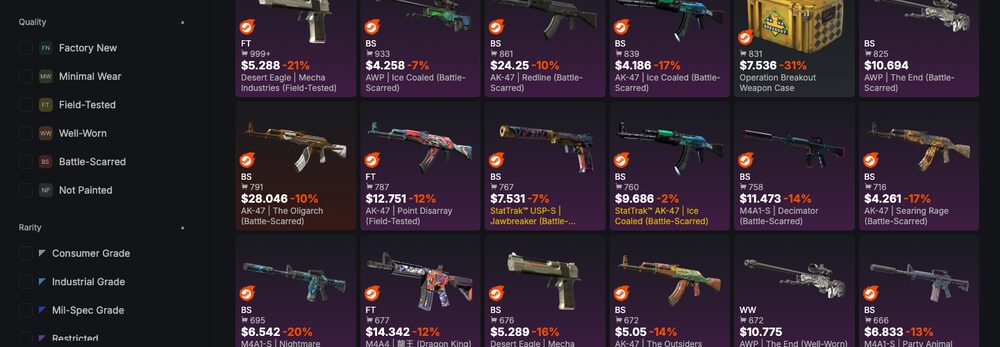
Why the first seconds decide everything
Browse any marketplace sorted by "lowest price" and you're looking at the survivors — listings that nobody wanted at that price. The interesting inventory never reaches that view. A skin priced meaningfully under its going rate gets taken while it's still at the top of the "newest" feed, which is why deep-discount snipes are almost always new-listing snipes. Per third-party trackers, genuinely underpriced listings on liquid items commonly disappear in seconds to low minutes; on sleepy venues or off-peak hours they can linger longer, but nobody sane plans around that.
The corollary: your reference price has to be loaded before the listing appears. There is no time to research an item once it's live. New-listing snipers work from a watchlist they already know how to value — anything else in the feed is noise, however cheap it looks. A "-40%" you can't verify instantly is a badge, not a discount.
How new-listing feeds actually work
Every venue exposes fresh inventory somehow; the differences are in latency and granularity. Broadly, as of late 2026 you see three mechanisms:
- The "newest" sort. Universally available, and the slowest possible view — you see listings only as often as you refresh, and the page itself may be cached for seconds. This is where manual snipers live, and why they mostly lose on liquid items.
- Polled APIs. Most marketplaces let tools query recent listings at some rate-limited interval. Your effective latency is the polling gap plus processing — commonly a few seconds end to end for well-built scanners. Rate limits mean a tool watching everything polls each item family less often than a tool watching a short list.
- Push feeds. Some venues stream listing events (websockets or similar) to integrated tools. This is the low-latency tier where the bot race is actually decided; by the time a pushed listing would have appeared in your browser tab, it has often already been evaluated by dozens of machines.
The practical takeaway isn't "get the fastest feed" — it's that your strategy must match your feed. On a refresh-tier setup, don't contest liquid, obviously-cheap items; you'll fund someone's screenshot collection. Hunt where evaluation is slow (patterns, crafts, odd floats) or where feeds are quiet.
Instant-buy vs the cart race
Detection is half the race. The other half is checkout, and venues differ sharply in how they resolve two buyers hitting the same listing:
| Checkout model | How it resolves | What kills you |
|---|---|---|
| Direct instant-buy | First confirmed purchase wins, others error out | Balance top-up mid-race; confirmation dialogs |
| Cart then pay | Item may be held briefly in cart, or not held at all | Payment friction; hold expiring while you type |
| P2P offer flow | Seller must come online to deliver | Seller cancels after seeing what they listed |
Two habits separate filled snipes from stories about them. First, keep a funded balance on the venues you hunt — dry powder beats a faster feed if the faster feed ends at a payment form. Second, strip every removable click from your checkout: saved payment method, no optional confirmations, muscle memory for the buy flow. Seconds spent in dialogs are seconds someone else's script doesn't spend.
Cancel windows: when a won race unwinds
Buying the listing isn't always the end. On peer-to-peer venues the seller still has to deliver, and a seller who fat-fingered a price commonly just… doesn't. Depending on the venue, non-delivery leads to an auto-cancel and refund after some window; annoying, but you're only out the time. Some marketplaces penalize sellers for cancelling, which improves your odds without guaranteeing anything. On-site-inventory venues are cleaner — the item is already custodied, so a confirmed purchase generally sticks — which is one reason instant-sold inventory is popular hunting ground despite thinner discounts.
Budget for a real cancel rate on the deepest P2P discounts. The listings most worth sniping are exactly the ones sellers most regret, and regret has a cancel button. If your PnL math assumes every won race settles, it's fiction.
After the buy: the lock is part of the trade
The purchase clears and the skin is yours — in roughly a week. Valve-side trade locks mean a sniped item generally can't move to a buyer immediately, and venues layer their own rules on top. For flippers this is the silent tax on new-listing sniping: your capital is committed at purchase, but your exit price is set a week later, after whatever the market does in between. Price that risk into the discount you demand — a thin edge on a volatile item can evaporate inside the lock.
It also reframes who new-listing sniping is for. If you're accumulating rather than flipping, the lock costs you nothing — and you may not need the race at all. A standing rule that buys your target items whenever they list under your ceiling captures the same mispricings without you watching a feed. That's the posture this blog's own product is built around: cs2stack (free account, non-custodial) watches live lowest prices across DMarket and SkinBaron and its autobuy fills under your per-item ceiling within a daily budget — autobuy as a standing order rather than a reflex contest.
Either way, the honest framing stands: the first seconds of a listing's life belong to whoever prepared before it existed. Reference prices loaded, balance funded, filters tuned, checkout rehearsed. The feed only looks like luck from the outside.