
Snipe Now or Set a Standing Order? Choosing Your Buying Posture
Every skin buyer eventually faces the same fork. Posture one: hunt — watch feeds, chase listings, win races. Posture two: wait — publish a price you'd pay and let sellers come to you. Both harvest the same underlying resource (other people's urgency); they differ in who moves first, what the win rate looks like, and how much of your life the strategy consumes. Most people pick by temperament. It's worth picking by arithmetic instead.
The reaction game
Sniping proper is a reaction game: a mispriced listing appears, and value flows to whoever responds first. Its economics are seductive at the top — single fills at 30–40% off exist — but the structure underneath is harsh:
- You compete on latency, against automation that measures response in milliseconds. On liquid items, human reaction is no longer a competitive category.
- Opportunities arrive on the market's schedule, not yours — which is why serious manual snipers end up organized around feed-watching hours, and why the time cost quietly dominates the P&L.
- The wins are lumpy. Weeks of nothing, then a fat fill. Fine for a hobbyist; psychologically corrosive for anyone treating it as income.
The patience game
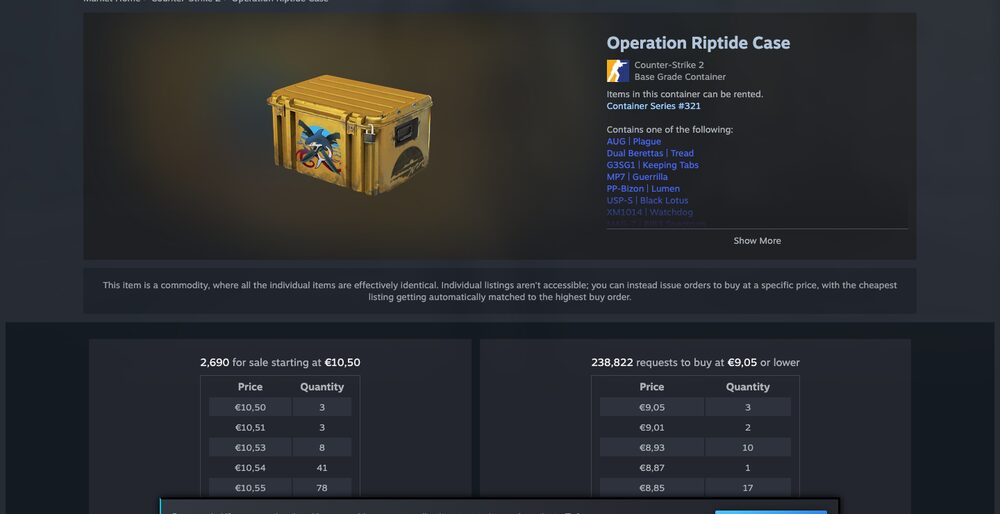
The standing order inverts everything: you publish your price — as a buy order on venues that support them, or as a private price cap that a bot executes against — and wait for the market to cross it. Now you are the liquidity, and every urgent seller who prices to sell in minutes is potentially selling to you. The trade-offs mirror the reaction game exactly:
- No races. A standing order can't be outrun; it's already there. Speed stops being a variable at all.
- No screen time. The strategy runs whether you're watching or not — the entire premise of price caps as standing orders.
- Smaller per-fill discounts, usually. Your order sits at a public-ish level; the spectacular one-off mispricing often gets picked off by hunters before it reaches your line. The patience game harvests the market's ordinary dips and urgency flow, not its fat fingers.
- Fill timing is uncertain. Set the ceiling too low and you own nothing for months. The knob is explicit: price aggressiveness buys fill probability.
The comparison, quantified as honestly as possible
Exact numbers depend on items, hours, and skill — treat these as structural tendencies, not measurements:
| Reaction game (sniping) | Patience game (standing orders) | |
|---|---|---|
| Typical per-fill discount | Large when won (can be 20–40%) | Modest but steady (single digits to ~20% on dips) |
| Fill frequency | Rare; competition-gated | Regular; price-gated, you choose the trade-off |
| Time cost | High and ongoing | Setup once, near-zero after |
| Main competitor | Faster snipers and bots | Other resting bids at your level |
| Failure mode | Winning bad deals under time pressure | Ceilings so tight nothing ever fills |
| Best suited to | Flippers with a knowledge niche | Accumulators and busy people |
The line that decides most cases: if you're buying to resell, you need the fat discounts, so you must hunt; if you're buying to hold, the steady discounts compound fine, so you should wait. An accumulator who captures a modest discount on every buy, every week, with zero hours spent, typically ends up better off than one who lands an occasional trophy snipe between long droughts — the same logic worked through in sniping vs DCA.
The hybrid most people should actually run
The postures aren't exclusive; they layer naturally:
- Base layer — standing rules on the items you accumulate anyway: a ceiling under the current market, filled automatically on red days and urgent sellers. Where venues support native buy orders, use them (CSFloat's implementation is the canonical example); where they don't, a capped bot provides the same posture.
- Opportunistic layer — alerts, not feeds, for the one or two niches where you hold genuine valuation edge, per the alerts-vs-autobuy split: automate the rule-clean, keep the judgment calls.
- Nothing else. The middle — manually racing liquid listings without an edge — is the layer that costs time and returns mistakes.
One implementation detail decides whether the base layer works: where the ceiling sits. Set it at the current market price and you're just buying — no edge, instant fills. Set it 40% under and you'll fill once a year. The useful zone is typically a modest notch below the item's recent trading range — deep enough that fills coincide with dips and urgent sellers, shallow enough that normal volatility crosses it every few weeks. Review the ceilings monthly, not daily: a standing order you constantly fiddle with is just slow manual trading with extra steps.
Deciding in one paragraph
Ask what you'd do with a fill: resell it, or keep it? Resellers should hunt, narrowly, in a niche they can out-value the bots on — and accept the hours as a real cost. Keepers should set ceilings and go live their lives; the cash-market discount is already structural (roughly 30% under Steam prices before any sniping cleverness), and standing rules skim the dips on top. That second posture is literally what cs2stack is — capped standing orders on DMarket and SkinBaron, run publicly on the founder's $20/day with every fill on the ledger — but the posture works whoever implements it, including you with a spreadsheet and native buy orders.