
cs2stack: An Automated Buying Desk for CS2 Cases
This is the product post, so let's set expectations up front: cs2stack is pre-launch, it only buys, it doesn't pick winners, and it will never promise you a return. What it does is run the boring half of case stacking — the daily shopping — better than a human can, and prove it with receipts. Here's the tour, honestly.
The problem it exists to solve
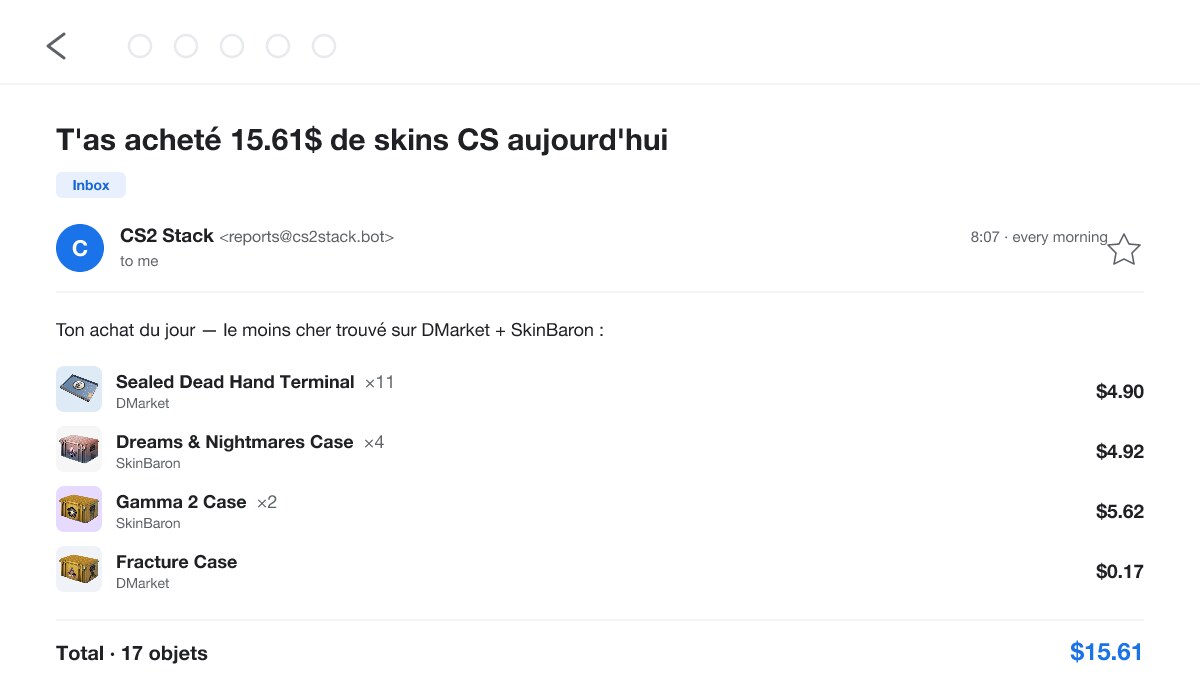
Case stacking with dollar-cost averaging is a strategy anyone can describe in one sentence: buy the same list of cases, a little every day, at the best available price. Almost nobody can execute it for a year. The execution is a daily grind of checking two or three marketplaces, converting euro prices, staying under sensible ceilings, and writing down what you paid — and the grind is precisely why manual DCA quietly dies after a few weeks. cs2stack exists to be the switch away from that grind.
What one morning run looks like
Every day, on schedule, the tool wakes up with your plan — say, $20/day split across five cases — and does the following:
- Prices both venues. For each item on your list it fetches live listings from DMarket and SkinBaron. SkinBaron prices in euros, so those are converted at a daily rate before the comparison — no stale hard-coded rates.
- Buys the cheaper one. Whichever venue is cheaper after conversion gets the order, provided the price sits under your per-item cap. If both venues are above your cap, the item is skipped — no exceptions, no "just this once."
- Respects the budget. Spending stops at your daily cap, and there's a $500 hard cap above that no configuration can override. The caps are the whole safety story, covered in depth in budget caps.
- Writes it down. Every fill is appended to a money-exact purchase ledger committed to git — item, venue, price, currency, conversion rate. Append-only means history can't be quietly edited, which is the point of an audit trail.
- Emails you. A buy report after the run, a periodic performance summary, and a balance alert when a marketplace wallet runs low. That's the full inbox footprint — three emails, no engagement bait.
Plans, not orders
You don't tell cs2stack "buy a case now." You give it standing intent: a daily budget split across a list, or a schedule like "buy one of this case every week," or several of these at once. Multi-plan budgets let a $20/day accumulation plan run alongside a weekly single-item standing order without the two interfering. The founder's own config does exactly this — roughly $19–20 in daily fills across about five cases, plus one CS:GO Weapon Case every week, an item that trades around $110–120 on his ledger.
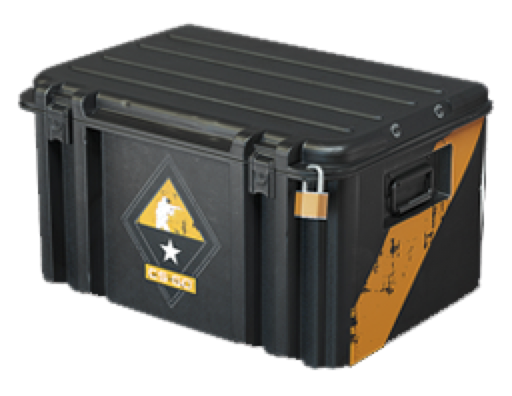
Item names are validated against live markets before a plan ever runs. This sounds like a trivial feature until it saves you: an early config contained a typo'd "Gamma 3 Case" — an item that does not exist — and validation caught it before a single cent moved. The alternative in a naive tool is silent failure or, worse, buying the wrong thing daily.
Safety before money
The tool defaults to DRY_RUN mode: it runs the full pipeline with real prices and fake money, showing you exactly what it would have bought, until you explicitly flip the switch. New items added to a plan start accumulating from day zero rather than retroactively "catching up" — a lesson learned when an early allocator tried to catch-up-buy 19 Gamma cases the day a line was added. And re-runs are idempotent: if a scheduled run fires twice, the purchase log prevents double buys. Each of these has its own post — dry runs, fresh starts, no double buys — because each one exists as a scar from real operation.
What it deliberately doesn't do
The omissions are features. cs2stack has no selling functionality at all — it's buy-side only, so a compromised config or a bug can accumulate items but never liquidate your inventory. It doesn't pick items; you choose the list, because automation executes strategy and humans set it, and any tool claiming otherwise is selling you its opinion. It doesn't snipe in the millisecond sense; it's a patient shopper, not a racing bot. And it doesn't guarantee anything about returns, because nobody honestly can in a market one company controls.
The proof model
Pre-launch software asking to touch your money should show its own. The founder runs cs2stack publicly on his own $20/day — the $20/day experiment — with the purchase ledger committed to git as an open record. Fills, prices, venues, the occasional skipped day: all of it visible. That's the standard we think any money-touching bot should meet, and it's the honest answer to "why trust this": don't trust it, read the ledger.
Who it's for, and who it isn't
It's for people who already believe in slow accumulation — stackers, DCA people, anyone who has felt the grind of manual daily buying — and want the discipline outsourced. It's not for traders chasing flips, sniper-bot users hunting mispriced floats, or anyone who wants a tool to tell them what to buy. If you're starting from zero, read getting started to see what a config actually looks like; it's shorter than you'd expect.
And if you're deciding whether any of this is worth it, the honest test is a month of doing it by hand first. Track the minutes spent, the days skipped, and the prices paid against the cheapest venue that day. Most people who run that experiment stop arguing with the premise — the grind either gets executed by software or it quietly stops getting executed at all.