A Full CS2 Loadout Under $50 (That Doesn't Look Cheap)
Fifty dollars doesn't buy a knife. It doesn't buy gloves. What it does buy — if you spend it like someone who reads price tags — is a skin on every weapon you actually pull out in a match, with enough left over that none of them scream "starter pack." Here's a build that works, with every price hedged the way it should be: these are cash-market ballparks as of late 2026, and they drift. Check before you buy.
The philosophy: spend where your crosshair lives
A budget loadout fails when the money spreads evenly. You see your rifle for 70% of every round; you see your Negev never. So the allocation rule is brutal: roughly half the budget on the two rifles, a real allocation to the AWP and your pistols, and single-digit leftovers for everything else. Dark, clean finishes hide their wear tier and read as far more expensive than busy artwork bought at the same price — which is the entire trick of not looking cheap.
One more principle before the shopping list: buy everything on cash marketplaces, not Steam. The same list bought with Steam wallet funds costs meaningfully more in real money — the venue guide explains why — and at a $50 total, the venue discount is effectively a free pistol skin or two.
The build, slot by slot
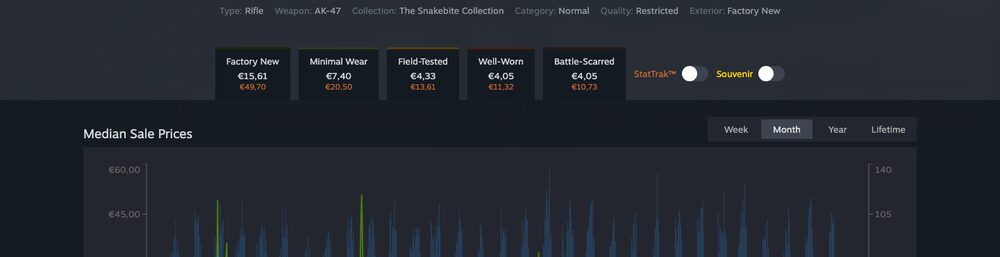
- AK-47 — Redline (Field-Tested), hovering around $15–20. The eternal answer. A decade old, iconic, and the red-on-black reads clean at any float. It eats the biggest slice of the budget because it's the skin you and everyone else will see most. If Redline drifts above your line, the Slate — often in the mid-single digits — is the darkest horse in the game.
- M4A4 — Magnesium or Evolved lines, low single digits. The CT rifle slot is where you save. Several modern dark-finish M4s trade in the $2–5 zone as of late 2026 and look flatly professional. M4A1-S players: the Basilisk sits in similar territory.
- AWP — Atheris (Field-Tested), roughly $4–6. The budget AWP with an actual color identity. If you AWP every round, steal a few dollars from the pistol section and consider the PAW or Chromatic Aberration around the same tier.
- USP-S — Ticket to Hell or Cortex, a few dollars. Both read far above their price. The legendary budget answer used to be the Cyrex; check which of the three is cheapest the day you buy.
- Glock-18 — Candy Apple or Water Elemental (FT), roughly $1–5. Candy Apple is the clean-and-cheap pick; Water Elemental is the personality pick, usually a couple of dollars more.
- Desert Eagle — Blaze if you're lucky in a dip, otherwise Mecha Industries, low single digits. The Deagle is the one pistol everyone inspects. Mecha Industries in Field-Tested looks like triple its price.
- P250 — Sand Dune, pocket change. Yes, the famous few-cent finish, and we're only half joking: a Sand Dune says you know exactly what this market is. If irony isn't your thing, the See Ya Later trades in the low single digits and is genuinely great.
Total: roughly $35–45 depending on the day, floats, and which alternates you pick — inside budget with room for a $3–5 flourish on whatever SMG you actually force-buy with.
The knife-and-gloves question
You can't have them at $50, and the workarounds are mostly traps. "Budget knives" in the $60–80 territory (heavy-wear Gut and Navaja finishes) technically exist one budget tier up, but they're the worst value in the game: maximum price for the finish nobody respects, and thin resale demand when you upgrade. Cheap "knife-adjacent" flexes that actually work: a StatTrak version of one of your cheap pistols (the orange counter reads as money), a well-chosen $2–4 sticker on your AK, or default knife animations and total indifference — which costs nothing and is, frankly, respected.
The honest play is to treat the knife as a separate savings goal rather than diluting this budget. If the upgrade path matters to you, the first-skin guide covers building toward bigger items without donating fees along the way.
Why liquidity is part of the shopping list
Every pick above shares a trait beyond price: they're liquid. Redlines, Water Elementals, and Atherises sell in hours on any major marketplace because demand is constant — which means this loadout isn't $50 spent, it's roughly $50 parked. When you outgrow a piece, it converts back to budget at a small haircut instead of sitting unsold for months. That's the difference between buying popular finishes and buying the obscure-collection curiosity that looked like a bargain; liquidity is invisible until the day you want out, and then it's everything. A corollary: prefer Field-Tested on everything dark. The tier discount is large, the visual difference on these finishes is small, and FT copies of famous skins are the most liquid objects in the entire market.
Buying it all without overpaying
A seven-item shopping list is where lazy buying gets expensive, because the 10–20% you leave on the table by one-clicking everything on the most convenient site is an entire slot of this budget. The fix costs seven minutes: run each item through the 60-second comparison workflow — aggregator check, two venues, fee adjustment — and buy each piece wherever it's actually cheapest that day. Cash markets move independently enough that your seven items will rarely all be cheapest in one place.
None of the picks here are sacred. The durable part is the method: allocate by screen time, buy dark finishes in Field-Tested, insist on liquid skins, compare venues per item, and hedge every price you read on the internet — including these. Run that method on any budget and the result never looks cheap; it looks chosen. And if you'd rather start even smaller, the under-$10 list is this article's little sibling.