CS2 Market Crash 2026: What to Do to Come Out a Winner
Per third-party trackers, the CS2 skin market has given back roughly half of a peak that once printed near $14 billion, and the vast majority of tracked skins lost value between March and the late summer of 2026. That is the bad news, and it is real. The other news is quieter: every previous crash in this market's thirteen-year history has minted a small group of people who came out the other side owning more, at better prices, than they ever could have during the euphoria. This is a guide to behaving like them.
First, the damage — honestly
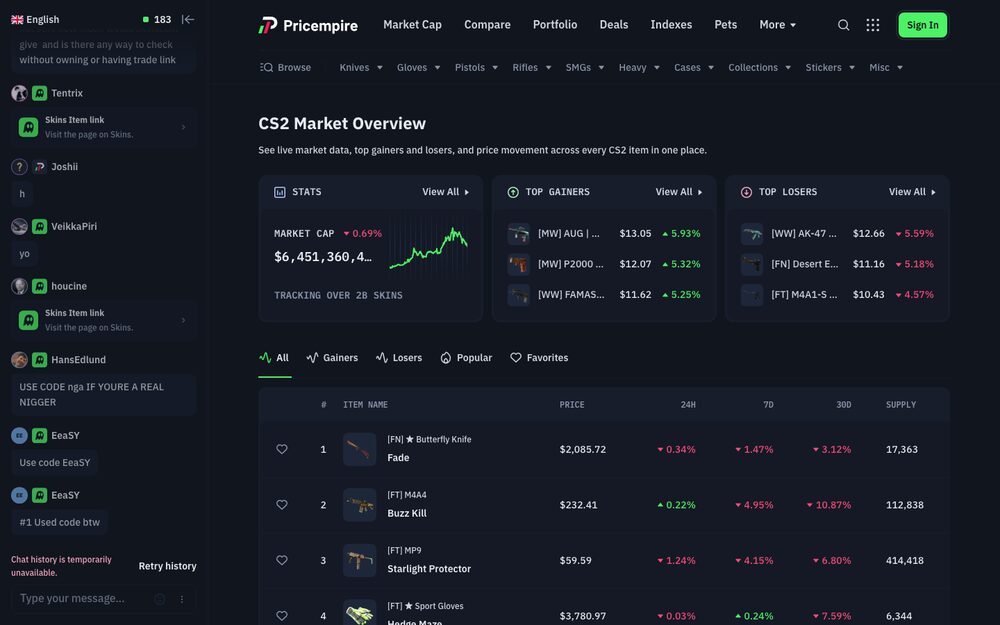
You cannot play a bad hand well while pretending it's a good one. The 2026 drawdown is one of the deepest this market has recorded: per third-party trackers and analyses, roughly 1,128 of 1,186 tracked skins — about 95% — lost value between March and mid-August 2026. Gloves broke first, down 10–20% by early in the year, and the weakness spread outward from there. Multiple forces stacked: Armory-driven case supply, a mid-May Valve update that touched drop rates and added cases, and a confidence spiral that turned sellers into panic-sellers. If you want the full sequence of dominoes, the 2026 crash timeline lays them out date by date.
Two things did not crash: player counts, which remain strong per public trackers, and Valve's own revenue engine, which third-party analyses put above a billion dollars for 2025. Demand for the game is intact. What repriced was the speculation layered on top of it — a distinction that matters enormously for what you do next.
Winner behavior #1: keep buying quality, on a fixed budget
The people who came out of past crashes ahead were not the ones who called the bottom. Nobody reliably calls bottoms — not here, not in equities, not anywhere. They were the ones who kept buying a fixed, survivable amount through the whole ugly stretch, so their average entry price ended up somewhere in the middle of the drawdown rather than at the top of the bubble. That's the entire logic of DCA through the 2026 crash: you stop needing to be right about timing and start needing only to be right about direction over years.
"Quality" is doing real work in that sentence. A halved market is not a coupon on everything — some assets were repriced for structural reasons and won't be back. The segments with a supply-side story still intact (discontinued cases whose supply burns permanently every time one is opened, liquid items with continuous unboxing demand) have historically recovered; hype-priced items without one often haven't. Buying the dip is a framework, not a slogan — define what you'd buy and at what ceiling before the market opens, not while staring at a red chart.

Winner behavior #2: write everything down
Crash-era decisions are made under emotional load, and memory is a liar under emotional load. Six months from now you will "remember" having been calm and systematic. A ledger keeps you honest. At minimum, log:
- Every buy: item, price, venue, date — and the reference price you bought against.
- Every skip: what you didn't buy and why. Skips are decisions too.
- Your thesis, dated: one paragraph on why you're accumulating. When fear spikes, you argue with the paragraph, not with your amygdala.
- Your budget cap: the number you will not exceed no matter how "generational" a dip looks.
This is also the cheapest edge available: most participants have no idea what their actual average entry is, so they can't tell whether they're winning. You will.
Winner behavior #3: hunt capitulation listings
Crashes produce a specific kind of seller: someone who has decided, tonight, that they're done. Their listings are priced to exit in minutes, and they routinely print well below even the crashed market rate. Sniping in a crash is a different game from bull-market sniping — reference prices are moving, so a "discount" needs to be measured against today's liquid mid, not last month's. But the deals are fatter and more frequent, because the panic is real and it isn't yours.
The practical setup: a short watchlist of items you'd own anyway, a hard ceiling per item set below the current mid, and alerts or standing rules that fire when a listing crosses it. Full disclosure, this is the product this blog is attached to — cs2stack watches live lowest prices across DMarket and SkinBaron and snipes your target items at your price, with hard caps and a dry-run default. The founder's own ledger kept buying $20 a day, publicly, straight through the crash.
Winner behavior #4: mute the obituary industry
Every crash produces the same content wave: the market is dead, it was always a scam, the smart money left. The historical hit rate of these obituaries is zero — the market has been declared dead after the 2018 trade holds, the 2019 key removal, the 2023 launch wobble, and the October 2025 trade-up shock, and recovered from all of them. That is not a guarantee it recovers this time. It is a strong reason to weight data over headlines: player counts, actual traded volumes, and supply mechanics, not engagement-optimized panic.
The same discipline applies in the other direction. When the bounce comes, the same channels will pivot to "the bottom is in" with equal confidence. Real bottom signals are boring: sellers exhausting, spreads tightening, supply news like the December 2025 Rare Drop Pool zeroing slowly working through inventories. Trade the boring signals.
What separates winners from tourists
Strip away the specifics and the split looks like this:
| Situation | Tourist response | Winner response |
|---|---|---|
| Prices down 40% | Sell everything, lock the loss | Re-check thesis; keep the schedule |
| Scary headline | Act on it within the hour | Check whether the data moved |
| Falling knife listing | All-in on one "steal" | Small buy inside a capped budget |
| Green week | FOMO back in at size | Same schedule as the red weeks |
| Record keeping | Vibes | Ledger, to the cent |
None of this promises a profit — a market run by one company can always surprise you, and surviving the crash financially and psychologically comes before winning it. Position sizes should assume the drawdown gets worse before it gets better. But if the market's thirteen-year pattern of repricing-then-recovering holds one more time, the people it pays will be the ones who treated 2026 as an accumulation window with rules — not the ones who watched, and not the ones who fled.