
Free vs Paid Sniping Tools: What the Subscription Actually Buys
Every sniping tool sells the same dream — buy under market, sell at market — but they price it very differently. Free tools genuinely cover most of what most people need: watching, filtering, alerting. The paid tier sells three specific upgrades: speed, venue coverage, and hands-free execution. Whether those upgrades are worth money depends on arithmetic, not vibes. This is the honest cost-benefit breakdown, tier by tier.
What the free tier actually includes
The free layer of the sniping stack is bigger than most newcomers expect. Across the tools we've reviewed, you can assemble all of this without spending a cent:
- Watching and alerts. CSWatcher's core watching and alerting is free — you define rules (item, price, float, venue) and get pinged when a listing matches. Per its public pages as of late 2026, the free tier is genuinely usable, not a crippled demo.
- Browser-level price context. Extensions like BetterFloat overlay reference prices on marketplace pages, so you can spot a below-market listing at a glance. The base extension is free; a Pro tier exists for power features. More in our BetterFloat review and the wider tour of deal-hunting extensions.
- Venue-native buy orders. Most marketplaces let you post a standing bid for free — the original autobuy, no subscription required.
- Full autobuy, in at least one case. cs2stack — disclosed: this blog's product — does watching, cross-venue comparison, and capped autobuy on DMarket and SkinBaron for free, because the product is pre-launch and the founder runs it on his own money.
That free stack covers the person who checks deals a few times a day, buys manually, and wants to stop overpaying. Which is, honestly, most people reading this.
What the subscription is really selling
Paid tiers cluster around three things the free stack can't give you:
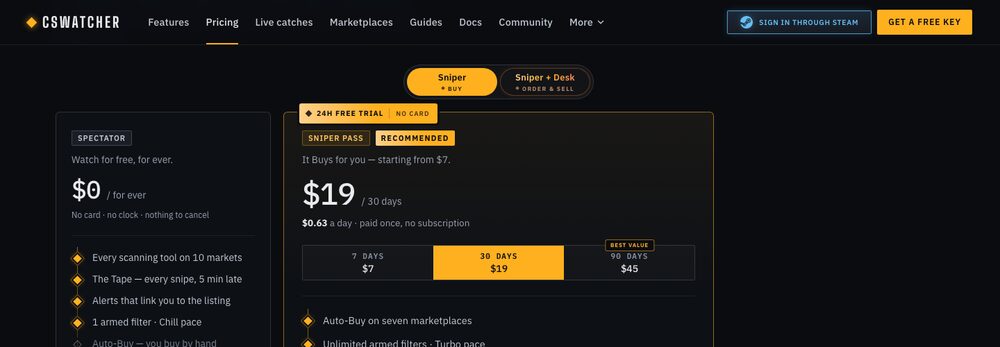
Execution. The big one. CSWatcher's watching is free, but hands-free autobuy — the bot pressing the buy button for you — is paid, sold as a non-renewing day pass running roughly $7 for 7 days up to $45 for 90 days per its public pricing in late 2026. You're not paying for information; you're paying for the robot's finger. Our full CSWatcher review covers the details.
Speed. On liquid items, mispriced listings die in seconds and the speed race is bot-vs-bot. Paid tools justify fees with faster polling, priority infrastructure, and lower alert latency. A free tool that pings you 30 seconds late is a history lesson, not an alert.
Venue coverage. Free tiers often watch a handful of markets; paid tiers watch more of them plus deeper filters (float ranges, patterns, sticker crafts). More venues means more raw deal flow — the input to everything else.
The deal-flow math: when a fee pays for itself
A subscription is a bet that captured edge exceeds the fee. Put numbers on it before you pay:
| Variable | Question to answer | Example |
|---|---|---|
| Fee | What does the period cost? | $45 / 90 days = $0.50/day |
| Extra fills | How many deals will the paid tier catch that free would miss? | 2 per week you'd otherwise lose to faster bots |
| Edge per fill | Average discount vs fair resale value, after fees | $3 on budget skins, $15+ on mid-tier |
| Break-even | Fee ÷ edge per fill = fills needed | $45 ÷ $3 = 15 extra fills per 90 days |
Two honest observations fall out of this table. First, the math scales with bankroll: someone deploying $50 a week on budget items needs the tool to be nearly perfect to recoup $45, while someone deploying $500 a week clears the bar with one good mid-tier snipe. Second, "extra fills" is the number everyone overestimates. The paid tier doesn't create deals; it wins races you were losing — and on contested liquid items, other paid bots are in the same race. Whether that edge still exists at all is the question we dig into in is sniping still profitable in 2026.
When free is genuinely enough
Skip the subscription if any of these describe you:
- You're accumulating, not flipping. If the goal is buying chosen items steadily below a ceiling, standing rules and buy orders do the job — speed is nearly irrelevant when the market comes to your price.
- Your budget is small. Under roughly $100 a month deployed, a $15–45 tool fee is a large percentage drag on any realistic edge.
- You hunt illiquid corners. Rare patterns and odd floats sit listed for hours because few bots watch them. An alert plus a human decision wins there — the case examined in alerts vs autobuy.
- You haven't proven the workflow manually. Paying for execution before you've profitably executed by hand is buying a faster car before you can drive.
When paying makes sense
The subscription earns its keep in one specific configuration: you flip liquid, contested items; your deal flow is limited by reaction time, not by capital or judgment; and your per-fill edge, after marketplace fees, is a comfortable multiple of the daily tool cost. Resellers restocking inventory and high-volume flippers live here. If that's you, a day pass is a cheap experiment — CSWatcher's non-renewing model is actually well-suited to testing, since there's no subscription to forget to cancel. Run it for a week, count the fills free wouldn't have caught, and let the ledger decide. The broader field is ranked in the best autobuy tools of 2026.
And if you're tempted by the third option — building your own bot to dodge fees forever — read build vs buy first. Your hours are also a fee; they're just billed in a currency people forget to count.